
Firgun Ventures Insight
Why quantum keeps coming back to the SPAC window
Zeynep Koruturk, Donald Harmitt & Dr. Kris Naudts
If you follow financial markets even loosely, you will have heard the backlash against special purpose acquisition companies (SPACs). After a frenzy of deal-making in 2020 and 2021 (during Covid), these vehicles acquired a reputation as speculative shortcuts to public markets, a way for companies that could not withstand the scrutiny of a traditional IPO to reach public investors anyway. The correction that followed was harsh and the consensus view hardened even further. SPACs were seen as an offspring of the zero-interest-rate era, unlikely to return in serious form. Despite this, while the broader SPAC market has contracted sharply, quantum is one of the few deep-tech sectors where SPACs have demonstrated genuine staying power. In the first quarter of 2026 alone, seven separate quantum companies announced or completed SPAC mergers, collectively aiming to raise over $1.5bn as mentioned in the Financial Times. Q2 has already seen IQM become the first European quantum computing company to list via a SPAC on Nasdaq. This is not a speculative echo of 2021 as the companies are more mature, the deal structures are more sophisticated, and the strategic logic more compelling. Understanding why tells us something important not just about SPACs, but about the capital dynamics shaping the quantum industry.
What is a SPAC, and why does it matter for quantum?
A SPAC is essentially a blank-cheque vehicle. A group of sponsors raises money from investors through an IPO, parks that cash in a trust account, and then goes looking for a private company to merge with. When the sponsors find an acquisition target, the two entities combine, and the formerly private company becomes publicly listed. Investors who bought into the SPAC can choose to redeem their shares if they do not like the proposed merger, and additional funding is typically raised from institutional investors through what is called a private investment in public equity (PIPE) to top up the capital available to the combined company.
This is different from a traditional IPO, where a company lists its own shares directly and is typically expected to demonstrate established revenue and clear profitability pathways. It is also distinct from a reverse merger, where a private company acquires an existing public shell to gain a stock exchange listing without raising new capital. The SPAC sits somewhere in between, providing the listing mechanism of a reverse merger but, crucially, raises fresh capital like an IPO. For quantum companies, this distinction matters enormously. Most still have limited revenue and commercialisation timelines stretching across relatively long horizons. This is firmly supported by a compelling long-term technological thesis, significant intellectual property, and growing strategic relevance to governments and corporations. SPACs allow these companies to present a forward-looking investment case directly to investors, relying primarily on where the technology is heading.
Why quantum keeps coming back
The geopolitical context here is important, given quantum technology is not just a computing story. It has the potential to redefine security, communications, and even national sovereignty, which is why governments in the US, Europe, and China are investing at scale. Government programmes and selective non-dilutive funding such as DARPA play an important role, but they are not substitutes for private growth capital, and the venture capital industry’s heavy tilt towards software over the past decade has left quantum with a shortage of growth-stage investors who have both the deep-tech expertise and the balance sheet to fund hardware companies through to scale. That gap is part of the reason so many quantum companies are turning to SPACs, as most do not believe they can raise the $300 to $600 million in private markets, and a public listing opens access to a far broader investor base.
The pattern over the past five years has begun to paint an interesting picture. Between 2021 and 2022, the first wave of quantum SPACs brought IonQ (which uses trapped-ion technology), Rigetti Computing (superconducting qubits), and D-Wave Quantum (quantum annealing) to public markets. Zapata Computing, a quantum software company spun out of Harvard, followed with its SPAC merger completing in early 2024. These were pioneering transactions that established quantum as a publicly investable category for the first time. Then came a difficult middle period in which stock prices tumbled, scepticism grew, and Zapata’s eventual collapse in late 2024 reinforced every negative narrative about SPACs and quantum alike. However, what happened next was somewhat unexpected. The stocks of the hardware-focused companies rebounded strongly through 2025, and a second, materially different wave of SPAC activity began.
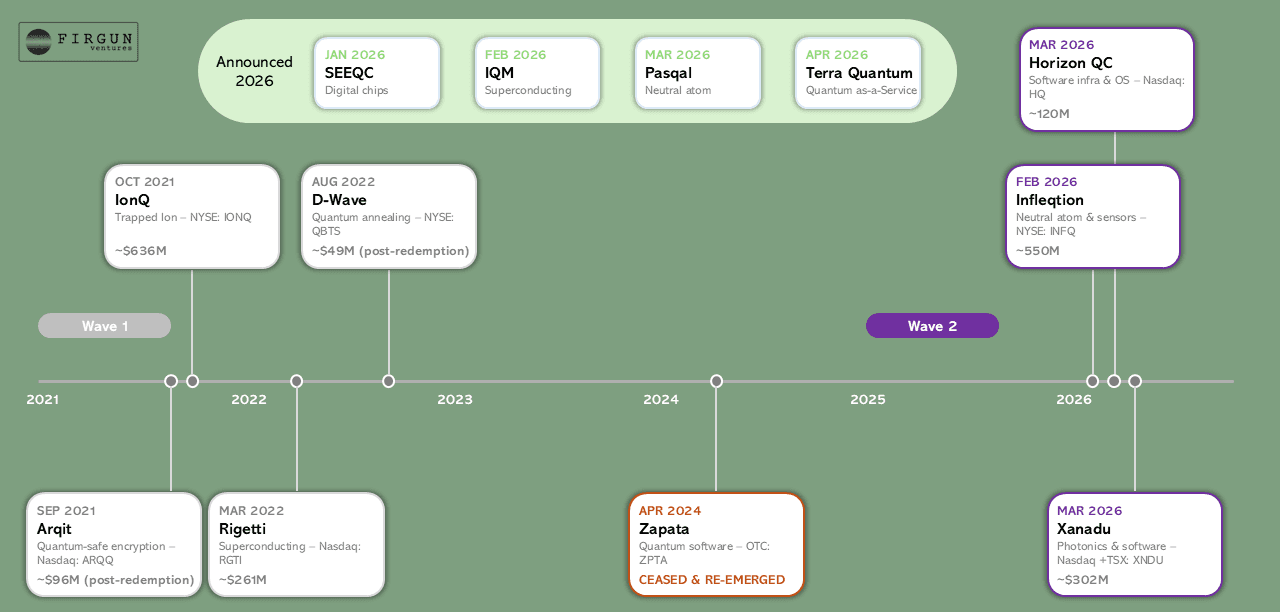
Figure 1: Quantum-related SPACs timeline (2021- April 2026)
Winners, losers, and the hardware advantage
The divergence in outcomes from Wave 1 follows a pattern worth delving into further. Surprisingly, or not, the hardware computing companies have fared best to date. IonQ trades at over $50 per share as of early July 2026, with a market value around $20 billion. It became the first public quantum company to surpass $100 million in annual revenue in 2025. D-Wave, which takes a different approach through quantum annealing (a technique suited to specific types of optimisation problems), trades around $23 per share (as of July 2026) with a market capitalisation just under $9 billion. Rigetti, despite generating more modest revenue, maintains a market value above $6 billion (as of July 2026) on the strength of its technical milestones and defence partnerships. All three trade well above their original $10 SPAC listing baseline.
The single software-layer, non-computing play has struggled far more, as Zapata provided a cautionary non-hardware example. The stock fell 60% on its first day of trading, and within months the company had ceased operations entirely. It has since re-emerged as Zapata Quantum following a bankruptcy restructuring, but the episode sends an interesting signal to the wider industry. Public markets have shown willingness to fund quantum hardware bets with long time horizons, but considerably less patience for quantum software plays without clear commercial differentiation.
Wave 2 has bigger cheques and smarter structures
The second wave of quantum SPACs, which gathered momentum in late 2025 and accelerated through early 2026, looks materially different, as the deals are substantially larger. Infleqtion completed its NYSE listing in February 2026 following a merger with Churchill Capital Corp X, raising over $540 million in the process. Close behind, Xanadu closed its dual Nasdaq and TSX listing in March 2026, becoming the first publicly traded photonic quantum computing company and bringing in approximately $500 million including its PIPE.
European quantum computing companies are following suit. In July 2026, IQM became the first European quantum computing company to list via a SPAC on the Nasdaq (IQMX) following a merger with Real Asset Acquisition Corp with an implied pre-money equity valuation of ~$1.8B. The deal stands out because IQM brings a relatively mature superconducting platform to market, with on premises and cloud access, 23 systems sold, 18 delivered, and €31 million of audited 2025 revenue. Its listing gives Europe a public market reference point based not only on scientific promise, but also on early commercial traction. Another European quantum giant, Pasqal, announced its combination with Bleichroeder Acquisition Corp II in March 2026 at a $2.0 billion pre-money valuation, with $200 million in convertible financing and total proceeds expected to exceed $600 million. In a similar vein, Terra Quantum, a leading Swiss Quantum-as-a-Service player, has announced its intent to go public via a SPAC with Mountain Lake Acquisition Corp. II later in the year, at a $3.25 billion valuation.
The cheque sizes across the board are considerably larger compared to Wave 1, and more importantly, the structures are more sophisticated. Pasqal combined trust proceeds with convertible financing, providing institutional investors with downside protection while still channelling significant capital to the company. IQM is evaluating a dual listing in Helsinki alongside its US listing, maintaining European investor access. Xanadu negotiated a separate potential government investment of up to CAD $390 million, layering sovereign capital alongside private funding. The PIPE participants now include names such as Maverick Capital, Morgan Stanley’s Counterpoint Global, and BPIfrance, suggesting a meaningfully more sophisticated institutional base than the earlier cycle. For those with a venture capital lens, the SPAC has evolved in this sector from a speculative vehicle into something closer to a structured growth equity instrument, with the kinds of downside protections and capital discipline that institutional investors demand.
The growth capital gap hiding in plain sight
This is perhaps the most underappreciated factor driving quantum SPACs, and it is not, as is sometimes suggested, that the venture capital model is broken. It is that a specific layer of the capital stack is missing. Quantum hardware can be highly capital intensive, involve long development cycles and yet remain strategically important. In that context, SPACs did something traditional IPO markets rarely do for deep tech at this stage: they opened a funding window. Without that route, some of these companies may have stayed private longer, moved more slowly, or been forced into weaker financing structures. IonQ’s scale today and Infleqtion’s strong debut funding are the strongest evidence that public market access can accelerate the leaders.
The issue is not that early-stage venture capital has failed quantum by any means. Seed and Series A funding for quantum companies has been promising, and the pioneering investors who backed IonQ in 2015 or Rigetti in 2013 took the kind of long-horizon bets that venture capital is designed for. The gap emerges at the growth stage, where companies need significant capital to scale hardware, build manufacturing capacity, and bridge the road to commercial revenue. The venture industry’s centre of gravity has shifted so heavily towards software that relatively few growth-stage funds possess both the deep-tech expertise and the balance sheet to underwrite these rounds. The result is a funding vacuum, where quantum companies that have successfully de-risked their technology at the early stage find too few private-market options at the growth stage, and turn to SPACs not because public markets are the ideal home for pre-revenue deep tech, but because the alternative, staying private without adequate growth capital, is more detrimental.
However, there is a structural tension worth noting. In deep-tech fields where timelines to commercial scale can stretch into horizons longer than your typical SaaS timelines, SPAC mergers are not always primarily about funding the company. Most venture funds operate on 7-10-year lifecycles. The earliest quantum investments (IonQ’s seed was in 2015, Rigetti’s in 2013) are now pressing up against fund maturity, meaning Limited Partners want returns and General Partners need distributions. The SPAC, in this light, is also serving the early investors’ need for a liquidity event amidst a relatively slow IPO and mergers & acquisitions (M&A) landscape.
Infleqtion’s quantum sensor escape hatch
The most strategically interesting case in Wave 2 may be Infleqtion, and the reason is not its quantum computer. Infleqtion is not primarily a computing company, at least not yet. It sells quantum RF sensors, atomic clocks, and inertial navigation systems to the US Department of Defense and NASA, today, generating approximately $29 million in trailing twelve-month revenue as of mid-2025 with roughly $50 million in booked and awarded business. Its quantum computing programme is progressing well (the company achieved 12 logical qubits with error detection ahead of schedule), but the near-term commercial thesis rests on sensing, not computing.
This represents a fundamentally different pitch architecture compared to Wave 1. Rather than asking public markets to fund a speculative hardware bet on a single modality, Infleqtion is effectively saying, we have commercially deployable quantum technologies, plural, and the quantum computer is the long-duration upside option. This acts as an escape hatch, a way to build a revenue bridge that insulates the company from the pure hardware commercialisation timeline.
Where this leaves us
The quantum SPAC landscape tells a story that is more nuanced than either the sceptics or the enthusiasts typically allow. The first wave opened a door that had never existed for deep-tech hardware companies at this stage of maturity, and the results were mixed but not uniformly negative. The hardware players survived, grew, and in several cases are now generating meaningful revenue. The second wave is structurally stronger with larger cheques, more sophisticated investors, better downside protections, and companies further along their commercialisation paths.
The persistence of SPAC activity in quantum, even as the broader SPAC market has contracted, is not simply a story about creative financial engineering. It is a symptom of a deeper structural gap: the shortage of specialised growth-stage capital willing and able to fund deep-tech hardware companies through the middle years between early research and commercial scale. The capital structures that fund quantum need to reflect the reality that this technology has the potential to redefine security, communications and national sovereignty. This is exactly where quantum-focused funds such as Firgun Ventures are positioned to address the need.
With that being said, the challenges very much remain real and should not be ignored. The prospects for fault-tolerant quantum computing remain highly promising, but the question of when it will reach commercial viability is still open. For investors, and for a quantum-specialised fund like Firgun Ventures, the critical task is distinguishing the companies building durable quantum businesses from those whose valuations rest on a single long-horizon hardware bet and a compelling slide deck. The quantum sector needs more investors with the expertise, patience, and conviction to fund these companies at the growth stage, before the SPAC becomes the only option left on the table. That distinction will play a pivotal role in determining which quantum companies are still compounding a decade from now.
Insights