
Firgun Ventures Insight
The Discreet Maturation of Quantum Sensing Supercharging GPS Capabilities
Dr. Kris Naudts, Zeynep Koruturk & Donald Harmitt
Most conversations about quantum technology begin and end with the quantum computer, while another part of the stack edging very close to real-world deployment receives a fraction of the attention. That part is quantum sensing.
Quantum sensing, one of the broad domains of quantum technologies, has moved from laboratory novelty to deployable capability faster than your typical deep technology; the reason is technical but worth understanding. Quantum sensors require far fewer qubits than computers, tolerate higher error rates, and operate in more forgiving environments. They do not need the elaborate error correction that has challenged fault-tolerant computing. In many cases they already outperform their classical counterparts, and the question has shifted from whether the physics works towards engineering questions such as whether the device can be shrunk, ruggedised, and integrated into platforms that were never designed with quantum technology in mind.
Why navigation quietly became a quantum problem
For most of the past three decades, knowing where you are has been treated as a solved problem. The Global Positioning System (GPS) and its peers, including Europe’s Galileo, Russia’s GLONASS, and China’s BeiDou, form a constellation of four global navigation systems that the world economy has quietly woven into container shipping, emergency response, and high-frequency trading alike.
The trouble is that these signals are extraordinarily faint by the time they reach the ground, which makes them trivially easy to disrupt. Jamming floods the relevant frequency with noise and denies a receiver any signal at all. Spoofing is more sophisticated, broadcasting a counterfeit signal that the receiver accepts as genuine and uses to compute a false position. Both have moved from theoretical concerns to operational realities, amplified by geopolitical instability.
European ministers reported in 2025 that GPS interference attributable to Russia and Belarus had been observed across the Baltic since 2022, with Estonia recording disruption on roughly 85% of its flights and Lithuania logging more than 1,000 jamming events in a single month. In March 2026, electronic interference around the Strait of Hormuz, which carries roughly 20% of the world’s seaborne oil and gas, distorted the navigation systems of more than 1,100 vessels in a single 24-hour period with tracking signals appearing nonsensically over airfields, nuclear sites, and inland deserts. UK government modelling has put the cost of a 7-day GNSS outage at £7.6 billion, with emergency services, maritime, and road transport accounting for nearly 88% of the loss. The vulnerability has moved well past theoretical, and it is growing at a rate that should give policymakers pause.
Finding your bearings without a satellite
Quantum sensing does not replace satellites so much as it offers an alternative reference frame: the Earth itself. The planet’s magnetic and gravitational fields vary subtly but predictably across its surface, producing a signature as distinctive as a fingerprint. A sensor sufficiently precise to read those variations, combined with a high-resolution map, can locate itself without needing any external signal at all. This is the principle behind magnetic anomaly navigation, often shortened to MagNav, and its gravitational equivalent. The approach is conceptually similar to how radar transformed aviation in the mid-20th century, opening up navigation in conditions where pilots had previously been effectively blind.
Several different quantum techniques contribute to this picture. Atom interferometers measure the tiny phase shifts that ultra-cold atoms accumulate as they move through space, providing inertial measurements roughly ten times more stable than the best classical gyroscopes and accelerometers. Optical atomic clocks deliver timekeeping precise enough that, over long missions, a vessel can dead-reckon (calculating a new position based on the last known fix, heading, speed, and time) its position with extraordinary accuracy. Quantum magnetometers and gravimeters read the Earth’s fields directly, the former best suited to aircraft and the latter to ships and submarines. The common thread is precision and drift-free operation. A quantum-enabled platform can stay oriented for hours or days in environments where classical inertial systems would have wandered off course long before.
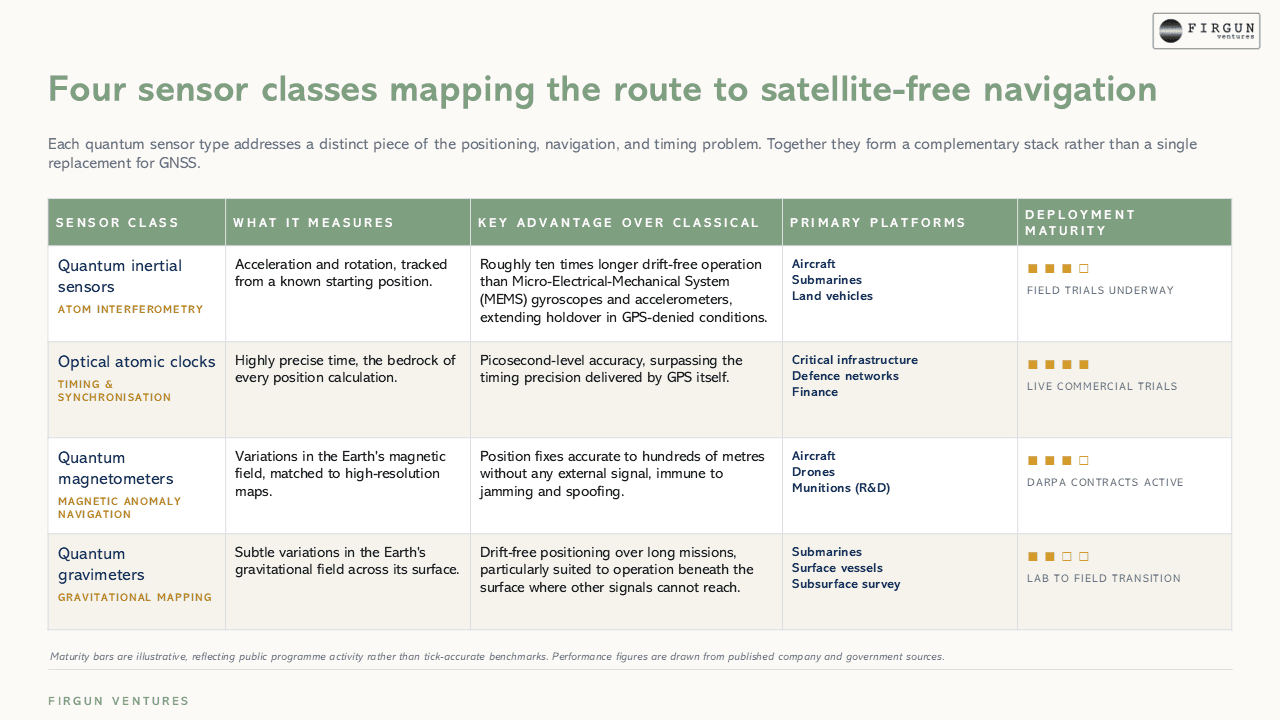
The four quantum sensor classes forming a complementary stack for satellite-free positioning, navigation, and timing.
Where the West is placing its bets
The strategic logic has not been lost on defense establishments. The US Defense Advanced Research Projects Agency (DARPA) has issued contracts to put quantum navigation systems through operational trials on military vehicles, and the US Naval Research Laboratory is focused on shrinking the technology to fit ships, submarines, and aircraft. The United Kingdom has gone further in framing quantum positioning, navigation, and timing as a national mission, with the Hub for Quantum Enabled Position, Navigation and Timing (QEPNT) anchoring research and two of the country’s five national quantum missions explicitly targeting satellite-free navigation on aircraft and networked sensors for critical transport infrastructure by 2030.
Industrial activity is now beginning to match policy commitments. Infleqtion has completed commercial flight trials of an un-jammable quantum navigation system and, in partnership with Safran Electronics, demonstrated picosecond-level timing accuracy in a live operational environment in April 2026, surpassing what GPS itself can deliver. A year prior, Lockheed Martin, Q-CTRL, and AOSense formed a partnership to develop a quantum-enabled navigation system for GPS-denied environments, with Q-CTRL’s magnetic-anomaly system, Ironstone Opal, the subject of two DARPA contracts aimed at packaging the technology into deployable form. This pattern shows that the underlying science is settled enough that the competition has shifted to engineering and integration.
Solving the engineering bottleneck is not an easy feat
It would be premature to declare the problem solved. The very sensitivity that makes quantum sensors valuable is also their weakness. A device that can detect the faintest gravitational variation will also pick up vibration, thermal drift, electromagnetic interference, and the noise of its own host platform. Magnetometers throw inauthentic readings near power systems, gravimeters lose stability in turbulence, and inertial packages still need periodic recalibration. Quantum inertial sensors also operate with longer measurement cycles than the kilohertz-rate accelerometers used in classical systems, which leaves them vulnerable to missing fast transients during high-dynamic manoeuvres. Many devices still require vacuum chambers, laser systems, and magnetic shielding that are difficult to compress into something a fighter jet or a drone can carry.
That is why quantum positioning, navigation, and timing today delivers most of its operational value in hybrid configurations rather than as a wholesale replacement. Pairing quantum sensors with classical inertial, acoustic, electromagnetic, and optical inputs, with machine learning filtering the combined stream, is what converts faint signals into reliable navigation tracks. Today, quantum is best understood here as a force multiplier for what existing systems already do, rather than a clean break from them. This pattern mirrors what we have seen in computing, where quantum processors sit alongside classical hardware rather than replacing it.
Preparing for a world with resilient positioning
The headline implication is one of national sovereignty. “Depending upon the sensing modalities, you could reverse that (stealth technology), so that all the advances you made on stealth could almost overnight suddenly disappear if you were able to detect those things at range”, is a crucial point made by John Ridge CBE, Chief Adoption Officer at the NATO Innovation Fund, on the Time to Talk Quantum podcast by Dr. Kris Naudts, Founding and Managing Partner at Firgun Ventures. The country that first operationalises quantum positioning, navigation, and timing at scale will reshape the parameters of submarine warfare, stealth aviation, and contested-spectrum operations.
The more subtle implication is commercial. Maritime shipping, aviation, autonomous vehicles, and critical infrastructure increasingly cannot afford to be hostage to a single, jammable signal from space. This is not going unaddressed. In May 2026, Infleqtion, working closely with the U.S. Army, introduced Quantum Spectrum, a new category within quantum sensing. Quantum Spectrum leverages atom-based radio-frequency (RF) sensing that detects, classifies, and authenticates signals to counter jamming and spoofing attacks, in situations where conventional receivers are inadequate.
The market for resilient positioning is no longer a defence niche. For policy makers, investors, and national entities, the read-across is that quantum sensing is one of the deep-tech categories where commercial revenue is already being booked, policy tailwinds are explicit and well-funded, and the near-term winners are likely to be the companies solving integration and miniaturisation.
Industrial revolutions rarely announce themselves. Navigation is the kind of capability layer that feels invisible until the moment it fails, and by then the advantage has usually already shifted. Quantum sensing is at exactly that point now.
Insights